
How to Automate Proposal Generation Without Sending Generic Quotes
Most founders we meet write every proposal from scratch. Not because they enjoy it, but because the last time someone else on the team tried, the pricing was wrong, the scope was vague, or the tone did not sound like the business at all. So the founder took it back, and it has stayed on their desk ever since.
That is not a proposal problem. That is a process problem wearing a proposal costume. Before you automate anything, it helps to understand why proposal generation breaks down in the first place, because automating a broken process just produces bad proposals faster.
Why proposal generation breaks down before it is ever automated
In most service businesses, the proposal process fails for one of three reasons.
First, pricing lives in someone's head, not in a document. There is no clear rate card, no standard way to scope a project, and no rule for what gets included versus quoted separately. Every proposal becomes a fresh negotiation with yourself.
Second, there is no template for structure. One proposal has three sections, the next has seven, and a client comparing two quotes from the same business cannot tell if they are looking at the same offer twice.
Third, nobody owns the follow-up. The proposal goes out, and then it sits in an inbox until someone remembers to chase it, usually weeks later, usually too late.
Automation can genuinely help with all three. It cannot fix any of them if the underlying process was never defined.
What actually deserves automating
Before you build anything, separate the parts of proposal generation that are mechanical from the parts that require judgement.
Worth automating
- Pulling client details, project scope notes, and prior conversation history into a pre-filled draft so nobody retypes information that already exists somewhere else.
- Populating standard pricing, packages, and line items from an approved rate card, so pricing is consistent no matter who sends the proposal.
- Formatting and branding the document, so every proposal looks like it came from the same business.
- Sending, tracking opens, and triggering a reminder if a proposal has not been actioned within an agreed window.
Worth keeping human
- The scope description for anything non-standard. A template can hold the shape, but a person needs to confirm the specifics match what was actually discussed.
- Any pricing exception. If a client is asking for something outside the standard package, that decision should route to whoever owns pricing, not get quietly approved by a workflow.
- The final read-through before it goes out. Automation should produce a draft, not a decision.
This is the same split that shows up in most of the builds covered in our guide to how to automate this: automate the retrieval and the repetition, keep judgement with a person.
Map it to a process before you build anything
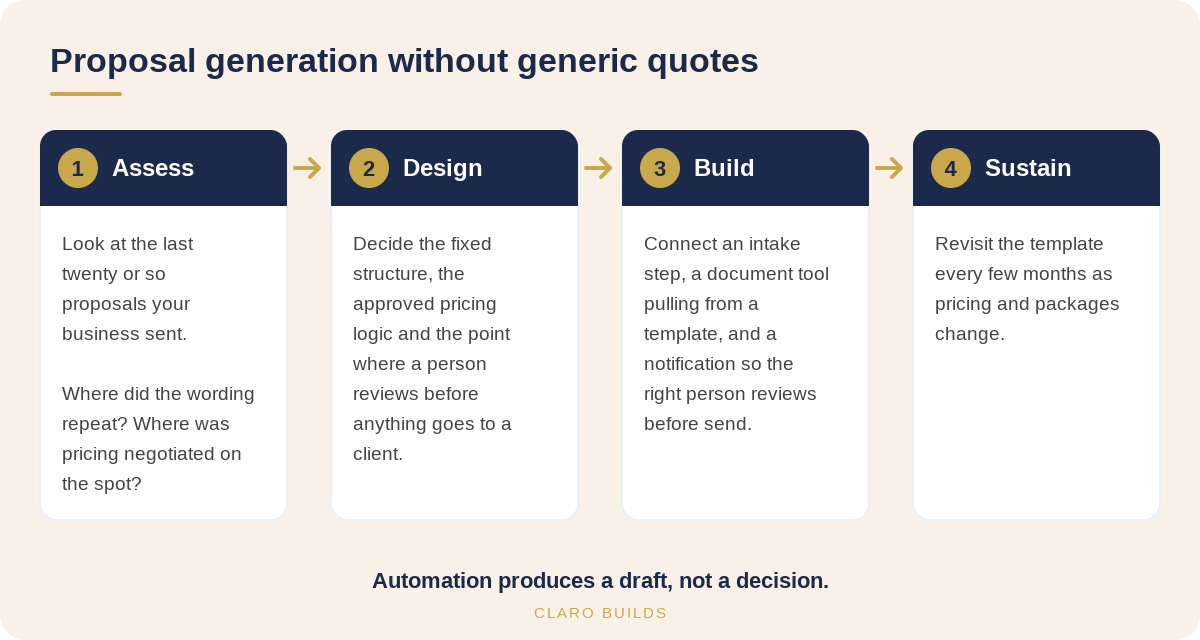
We run every build through the same four stages, which we call The Claro Build Framework: Assess, Design, Build, Sustain. For proposal generation, that means:
Assess: look at the last twenty or so proposals your business actually sent. Where did the wording repeat itself almost exactly? Where did pricing get negotiated on the spot? Those patterns tell you what to template and what to leave flexible.
Design: decide the proposal's fixed structure, the approved pricing logic, and the exact point where a human has to review before anything goes to a client.
Build: connect the tools. This is usually a form or intake step, a document generation tool pulling from a template, and a notification step so the right person reviews before send.
Sustain: revisit the template every few months. Pricing changes, packages change, and a proposal template nobody maintains quietly becomes another outdated document nobody trusts.
Where this connects to the rest of your pipeline
Proposal generation rarely lives on its own. It usually sits downstream of how leads get nurtured in the first place. If your lead follow-up is inconsistent, you will end up sending proposals to people who were never properly qualified, which wastes the time you just saved on drafting.
It also sits upstream of contracts and invoicing. A proposal that was templated, priced correctly, and approved before it went out becomes a clean source of truth for whatever comes next, whether that is a contract, a deposit invoice, or a project kickoff. A proposal that was rushed together on the spot tends to create small inconsistencies that someone else has to untangle weeks later.
What this looks like once it is built properly
A well-built proposal system usually looks unremarkable from the outside, which is the point. A team member fills in a short intake form or pulls information from an existing conversation. The system drafts a proposal using approved pricing and an approved structure. A designated reviewer, sometimes the founder, sometimes a sales lead, checks the scope and pricing lines against what was actually agreed, then approves it to send. The client receives a document that looks and reads exactly like every other proposal the business has sent, because it was never actually written from a blank page.
If a proposal does not get opened or actioned within an agreed window, a reminder goes out automatically, rather than depending on someone remembering to check a spreadsheet. None of this requires the founder to write a single sentence, but nothing goes out without a person confirming it is correct.
The handover that actually matters
Once a proposal system is built, the biggest risk is not the tool. It is that the person who built it is the only one who understands how it works. That is why every build we deliver is held to The Adoption Standard: a structured 45-minute handover call and documentation written as the system is built, so whoever owns proposals day to day knows exactly how the automation works, what it does not cover, and what to do when a client asks for something outside the template. That handover is not team-wide training, it is the minimum complete handover every build is held to.
How to know it is actually working
A proposal system is working when the founder can go a full week without personally drafting a quote, and the proposals that go out in that week are still accurate, on-brand, and priced correctly. It is also working when a new team member can send a proposal on their first week without needing to shadow someone first, because the template and the pricing rules carry the knowledge that used to live only in the founder's head.
If proposals still feel inconsistent after the system is live, the issue is almost never the software. It is usually that the underlying pricing or scoping rules were never fully agreed before the build started, which is exactly why the assessment stage matters as much as it does.
Common mistakes we see
The most common failure is treating proposal automation as a writing tool rather than a process. A business installs software that generates paragraphs of text, but the pricing behind those paragraphs is still inconsistent, so the automation just makes inconsistent proposals arrive faster.
The second common mistake is removing the human check entirely. A proposal is often the first serious document a prospective client reads from your business. Sending an unreviewed, automatically generated document undermines the trust you are trying to build before the relationship has even started.
The third is building the system once and never updating it. Pricing drifts, services change, and a proposal template becomes the thing everyone quietly works around instead of the thing everyone relies on.
Done properly, proposal automation gives you back hours every week and gives your clients a document that reads like it was written with care, because the parts that need care are still being handled by a person, and the parts that do not are finally out of your evenings.
Frequently Asked Questions
Can proposal generation be fully automated with no human involved?+
Not if you want it to stay accurate. The drafting, formatting, and pricing lookup can be automated, but scope confirmation and final review should stay with a person, especially for anything outside your standard packages.
What is the first thing to automate in proposal generation?+
Start with pricing consistency. Pull your standard rates and packages into one approved source so every proposal quotes from the same numbers, before you touch formatting or delivery.
How long does it take to build a proposal automation system?+
It depends on how standardised your pricing and scoping already are. A business with a clear rate card can usually move through assessment and design quickly. A business where pricing lives entirely in the founder's head needs that sorted first.
Does proposal automation work for custom or highly negotiated deals?+
It can still help with structure, branding, and tracking, but the pricing and scope sections should route through a human review step rather than auto-populating, since every deal is genuinely different.
How does this connect to The Adoption Standard?+
Every system we build, including proposal automation, is handed over with a structured 45-minute call and documentation written as we build it, so your team knows exactly how it works and where the human checkpoints are.

Lerato Kgonoti
Founder and Director, Claro Builds
Lerato Kgonoti is the founder and director of Claro Builds, an operations and AI consultancy helping small and medium-sized service businesses implement automation, integrate AI into their daily operations and equip their teams with the practical skills to keep up with an increasingly automated world. Lerato founded Claro Builds on the belief that AI should be accessible, practical and human, not a privilege reserved for large enterprises, but a genuine advantage available to every service business ready to use it. Through builds, audits and private workshops, Claro Builds closes the gap between where small businesses operate today and where they need to be.
Related Articles
How to Automate This: A Practical Guide to Deciding What to Automate First in Your Business
A practical, no-hype framework for deciding what to automate first in your business, before you buy any software or fix anything that was never broken in the first place.
How to Automate Client Communication Without Losing the Personal Touch
Automating client communication only feels robotic when you automate the wrong part of the conversation. Here is how to automate triage and drafting while keeping judgement calls with a person.
How to Automate Invoice Processing Without Losing Control Over Approvals
Automating invoice processing goes wrong in two directions: automating approvals away entirely, or automating nothing while still doing all the manual data entry. Here is how to automate the data extraction, PO matching and ERP updates while keeping a real person in the loop for anything above a threshold or genuinely unusual.