
How to Automate Vendor Follow-Up Without Damaging Supplier Relationships
Ask most operations teams how they track outstanding vendor orders, and the honest answer is somewhere between a shared spreadsheet and a person's memory. It works, roughly, until that person is on leave, or the spreadsheet falls a week out of date, and suddenly a delivery that was due two weeks ago has not been chased at all.
Vendor follow-up is one of the more overlooked parts of operations, because it does not fail loudly. It fails quietly, as a slow drip of late deliveries, missed reorders, and awkward calls asking a supplier where something has got to, three weeks after it should have arrived.
Why vendor follow-up breaks down
There are usually two failure modes, and they sit at opposite ends of the same problem. Some businesses under-follow-up: nobody owns tracking outstanding orders, so items slip past their expected delivery date unnoticed until a client or team member asks where something is.
Other businesses over-follow-up, chasing every supplier constantly regardless of whether anything is actually overdue, which strains a relationship you likely need to stay in good standing, especially with vendors your business depends on regularly.
Both problems come from the same root cause: nobody has a reliable, current view of what was ordered, when it was due, and what has actually arrived.
What is worth automating
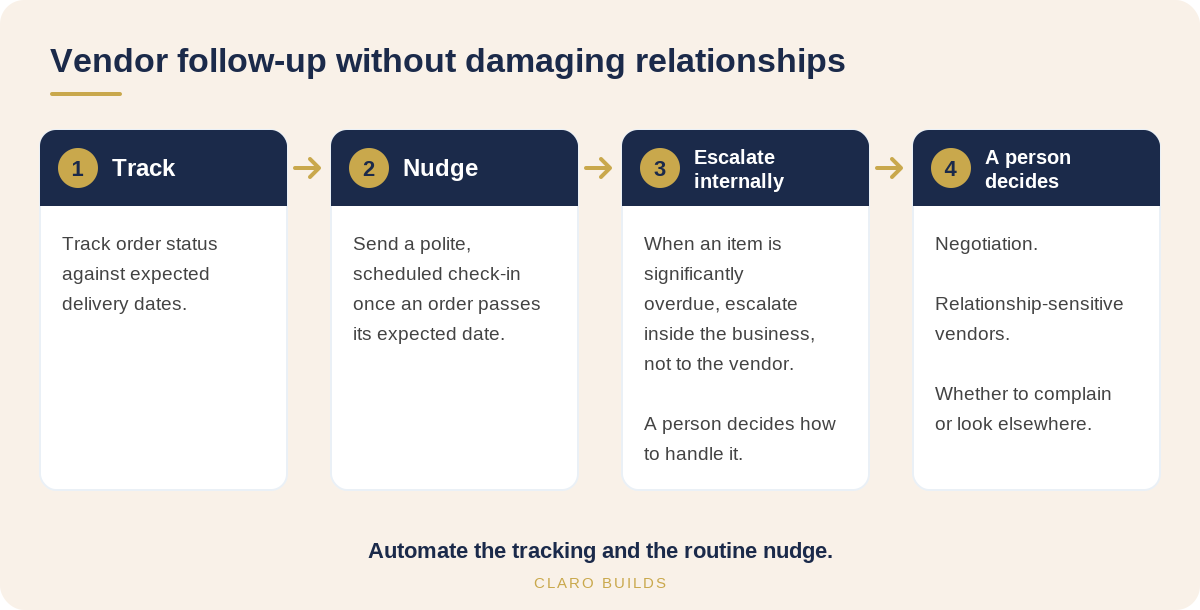
- Tracking order status against expected delivery dates, so the business always has a current view without anyone manually maintaining a spreadsheet.
- Sending a polite, scheduled check-in once an order passes its expected delivery date, rather than relying on someone to notice and remember to chase it.
- Escalating internally, not to the vendor, once an item is significantly overdue past an agreed threshold, so a person decides how to handle it rather than an automated message going out indefinitely.
- Flagging patterns, such as a specific vendor consistently running late, so your team has the information needed for a proper conversation about the relationship, not just the individual order.
What should stay human
- Any actual negotiation, whether that is pricing, timelines, or resolving a dispute. Automation can surface the information, but the conversation needs a person.
- Follow-up with vendors your business considers relationship-sensitive, where tone and timing matter more than speed.
- The decision to escalate to a formal complaint or to look elsewhere for a supplier. That is a business decision, not a workflow trigger.
This is the same principle behind every build in our guide to how to automate this: automate the tracking and the routine nudge, keep anything relationship-sensitive with a person.
How this connects to the rest of your operations
Vendor follow-up rarely stands alone. It usually connects directly to invoice processing, since a late delivery often means a late or disputed invoice too, and to bulk payments, since a business chasing overdue deliveries needs the same visibility over what it owes and when. Vendor follow-up and subscription or contract renewals also share a pattern worth understanding together, covered in our guide to automating subscription renewals: both are about not letting a date slip past unnoticed.
Building it properly
The same four-stage approach applies here as with any build, described fully in The Claro Build Framework. Assess means mapping every current vendor relationship and how follow-up actually happens today, not how it is meant to happen. Design means agreeing what counts as overdue for each vendor type, since a same-day courier and a six-week manufacturing order need very different thresholds. Build means connecting order data to a tracking and reminder system. Sustain means reviewing vendor thresholds periodically, because supplier relationships and lead times change as your business grows.
What good vendor follow-up actually feels like
From the vendor's side, good automated follow-up should feel like dealing with an organised business, not a persistent one. A message that arrives once an order is genuinely overdue, references the specific order, and asks a clear question reads as professional. A generic, repeated nudge that ignores whether the vendor already replied reads as exactly what it is: a system nobody is actually paying attention to.
From your team's side, the change should be equally noticeable. Instead of someone maintaining a mental list of which orders are outstanding, or discovering a problem only when a client asks where their order has got to, the team works from one current, trustworthy view of what has been ordered, what is due, and what needs attention. That shift, from reactive discovery to proactive visibility, is usually the biggest single improvement businesses report after getting this right.
A note on relationship-sensitive vendors
Not every vendor should be treated the same way by the system, and this is worth deciding deliberately rather than by default. A small number of your suppliers likely matter enough, whether due to cost, exclusivity, or the relationship itself, that any follow-up beyond a simple status check should go through a person rather than an automated message. Flag those vendors explicitly when you design the system, rather than assuming the automation will somehow know the difference on its own.
Setting thresholds that actually make sense
The single most important design decision in vendor follow-up automation is agreeing what counts as overdue for each type of order. Set the threshold too tight, and the system chases vendors before there is genuinely a problem, which wastes goodwill on non-issues. Set it too loose, and the business only finds out about a real delay once a client has already noticed and asked about it. Getting this right usually means looking at each vendor's typical lead time honestly, rather than applying one number across every supplier because it is easier to set up that way.
Keeping the vendor relationship in view, not just the order
It helps to remember that a single overdue order is rarely the full story with a vendor relationship. A supplier who is reliably on time apart from one unusual delay deserves a different tone, and a different level of patience, than one who is consistently late. Automated tracking gives your team the pattern across time, not just the single data point in front of them, which makes it far easier to have a fair, informed conversation when one is actually needed.
Common mistakes
The most common mistake is applying one follow-up rule to every vendor. A supplier you order from weekly needs a different cadence than one you use twice a year, and a single blanket rule usually ends up either too aggressive or too slow for most of your vendors.
The second is letting automated messages sound obviously automated. A vendor who feels like they are being chased by a robot is less likely to prioritise your order than one who feels like they are dealing with a business that pays attention.
The third is never closing the loop. If a delivery arrives but nobody updates the system, the automation keeps chasing a vendor for something that has already turned up, which damages trust faster than the original problem ever would have.
It is also worth revisiting these rules whenever your vendor list changes meaningfully, such as onboarding a new supplier or shifting more volume to an existing one. Thresholds and tone that suited your original set of vendors do not always suit a new one, and a quick review at that point tends to prevent the quiet mismatches that otherwise only surface once a vendor has already been annoyed by a message that did not fit the relationship.
Automated properly, vendor follow-up means nothing slips through unnoticed, and the relationships that matter most still get the human attention they need to stay strong.
Frequently Asked Questions
Will automating vendor follow-up make our messages feel robotic?+
Only if it is built poorly. A well-designed system sends the same considered message a person would send, on a schedule they would not reliably remember to keep, and routes anything sensitive to a human.
Should every vendor get the same follow-up schedule?+
No. A vendor you order from weekly needs a different threshold for what counts as overdue than one you use occasionally. Follow-up rules should be set per vendor type, not applied as one blanket rule.
What should trigger a human to step in instead of the automation?+
Any order significantly overdue past an agreed threshold, any dispute, and any vendor your business treats as relationship-sensitive should route to a person rather than continuing on an automated schedule.
How does vendor follow-up connect to invoice processing?+
A late delivery often leads directly to a late or disputed invoice, so businesses that automate both together get a much clearer, more current view of what is owed and what is outstanding.
How often should vendor follow-up rules be reviewed?+
Periodically, and whenever supplier relationships or typical lead times change. Thresholds set when a business was smaller or worked with different vendors tend to stop matching reality as the business grows.

Lerato Kgonoti
Founder and Director, Claro Builds
Lerato Kgonoti is the founder and director of Claro Builds, an operations and AI consultancy helping small and medium-sized service businesses implement automation, integrate AI into their daily operations and equip their teams with the practical skills to keep up with an increasingly automated world. Lerato founded Claro Builds on the belief that AI should be accessible, practical and human, not a privilege reserved for large enterprises, but a genuine advantage available to every service business ready to use it. Through builds, audits and private workshops, Claro Builds closes the gap between where small businesses operate today and where they need to be.
Related Articles
How to Automate This: A Practical Guide to Deciding What to Automate First in Your Business
A practical, no-hype framework for deciding what to automate first in your business, before you buy any software or fix anything that was never broken in the first place.
How to Automate Client Communication Without Losing the Personal Touch
Automating client communication only feels robotic when you automate the wrong part of the conversation. Here is how to automate triage and drafting while keeping judgement calls with a person.
How to Automate Invoice Processing Without Losing Control Over Approvals
Automating invoice processing goes wrong in two directions: automating approvals away entirely, or automating nothing while still doing all the manual data entry. Here is how to automate the data extraction, PO matching and ERP updates while keeping a real person in the loop for anything above a threshold or genuinely unusual.